The other day, I went to the American Folk Art Museum with Maisie, my first-cousin-once-removed. Maisie is a student at Barnard College. In all the time she’s been there, I have never invited her to our home, which is an hour away from her campus, or gotten together with her. Since she’s graduating this year, I was running out of time to assuage my guilt. We are first-cousins-once-removed, for heaven’s sake, and my son is her second cousin, plus we’re really close with her mother (my first cousin) and her husband. I was totally negligent regarding my older-cousin-once-removed duties. The crazy thing is that my family loves Maisie. Time just got away from us, which, of course, is no excuse. I had to make it up to her.
The museum, which is across from Lincoln Center in Manhattan, had moved since the last time I saw it (decades ago when my roommate worked there). It was always in the Lincoln Center area, but it used to be in a storefront. I think it had one room, but I’m not sure. I never actually went in. Whenever I met my roommate after work, I stood outside and waited for her. I was probably avoiding paying an entrance fee, which turned out to be unnecessary since there is not now, and never was, an admission charge. (You can feel free to tuck a bill or two into a prominently displayed lucite rectangle with a slit in the top, however.)
I assumed that the museum had moved to get more space. I was right. It now has three rooms. Three areas, really. We went looking for the rest of the museum after we had looked at the featured exhibit, “Securing the Shadow: Posthumous Portraiture in America,”and we were told that we had seen the entire museum—and that I should put my camera away right now, because photographs were forbidden in all but one area.
At least the featured exhibit–the only exhibit–was entertaining. One room displayed posthumous oil paintings, i.e., oddly proportioned depictions of children who had died before the paintings were commissioned. According to the explanation handwritten on one of the walls, before the invention of cameras, parents had no way to remember their deceased child or children once the memories faded. Up until fairly recently, children regularly died before reaching their second birthday (the “safe” birthday, when their chances for survival got better). In the 19th century, itinerant corpse painters were all the rage. They offered their services to mourning parents and were often hired by those who could afford an oil painting, plus the expense of housing and feeding the painter until he or she (usually he) finished. Having such a painting was a way to cheat death, according to the writing on the wall.
In another area, there was a wall essay which explained that, once in awhile, parents of one dead child and one living child would have a painting of each child made, so that the children would finally “meet,” since they never met in life. We saw some of those. We also saw paintings of whole families of children playing or standing together, even though not all of them were actually alive during the time the painting was done. Maisie and I both guessed who was dead in each picture, and then we’d check the painting’s documentation. She won that game.
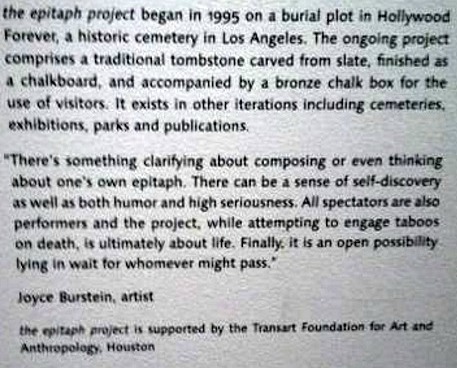
In that same room was a chalkboard tombstone, with chalk. Visitors could wipe the tombstone clean and write their own epitaphs. Again, the history
Posted on the wall of the American Folk Art Museum 10/13/2016. No photo credit for legal reasons.
of the chalkboard tombstone appeared on the wall behind the display.
In my opinion, the museum could save a lot of time and money if they just painted their walls in chalkboard paint. Then, when one exhibition moved out and another moved in, they could erase anything about the former and have a clean slate (oh, that’s where that expression came from!) for the latter, instead of having to repaint the walls.
Maisie and I couldn’t resist writing an epitaph.
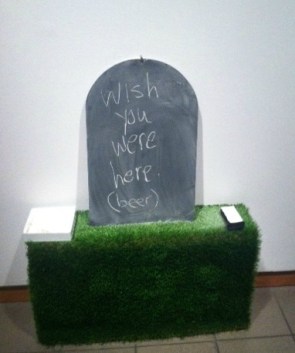 After a few tries, we came up with, “Wish you were here (beer).” Maisie added the “beer” part. I attributed this to her being a college student but she disabused me of my stereotypical assumption and said that last summer, when she and her parents were in China, they saw a toddler wearing a shirt emblazoned with, “Wish you were beer” and they thought that was hilarious. I had to agree.
We were permitted to photograph our tombstone in order to enter the project’s epitaph contest. If we’re lucky, our tombstone will soon appear on the iPad that is nailed to the wall and displays the most creative entries.
There was also an area dedicated to daguerreotypes. Daguerreotypes were early photographs that were taken in the mid-1800s. There were about 60 daguerreotypes, in velvet-lined, metal, bifold cases, which were displayed on a glass-topped table. Each daguerreotype was numbered. On the wall, someone had started listing each photograph by number with its history, but the task must have been overwhelming, because only 16 or so appeared. Unlike the oil paintings, which were strictly of children, posthumous daguerrotypes also included adults. There were photographs of deceased adults, as well as living adults holding deceased babies. Some of adults were propped up like they were alive, and some didn’t even try to fake it.
When we were ready to leave, we made a quick stop in the gift shop where it became apparent why no photographs of the paintings were allowed: they were selling postcards of the paintings and didn’t want to miss out on sales. They also sold disembodied wooden hands, distressed plaster casts of baby-head candleholders, and a three-pack of journals for planning your death down to the last detail.
Maisie wasn’t very hungry after viewing the exhibit, but my appetite wasn’t affected. We went to the nearby P.J. Clarke’s and had a lively debate over which paintings or photos were the most disturbing.
All in all, it was a fun night. I might have neglected Maisie for three years, but I’m fairly certain that this trip made up for it. I’m probably good for another few years. (Just kidding, Maisie’s mother.)
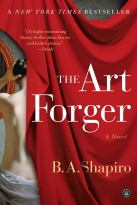 I can also tell you that it is fascinating, educational (but not in a dry way), mysterious, and character- and incident-driven. The protagonist is an artist with an intriguing past, artfully revealed little by little, and her evolving present is just as engrossing. I’ve read books where you are forced to go back and forth between the past and the present and different perspectives, and the flow becomes disappointingly disrupted. That doesn’t happen here. This author has a gift for segueing from one time or person to another.
 Hawkins. Today I saw the movie based on the book and it was spellbinding. There were moments in the story that were so tense that the audience collectively held its breath. I remember thinking, when I finished the book, that it was okay. It was better than the book it was compared to, Gone Girl (by Gillian Flynn), though, because while Gone Girl was remarkable for being so dark and unpredictable, the characters were sociopaths. The characters in The Girl on the Train—while far from ordinary—were relatable. And Emily Blunt was fabulous. Long story-short: See The Girl on the Train and read The Art Forger (if you haven’t already; both books were best sellers and people are turning out in droves for the movie). You will thank me. I accept gift cards.
 Patsy Porco's Blog: Free and Worth It!