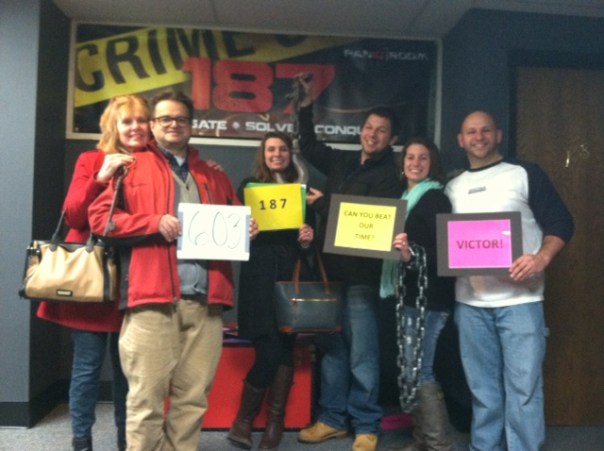
Last night, my husband, four strangers, and I went in search of a serial killer. We did all of the legwork in a locked room filled with trunks and desks bearing combination locks. Each lock was different. Some had number combinations. Some had up/down/left/right combinations. Some had number and letter combinations (but only some of the alphabet was represented). Each locked drawer or trunk held a clue or two. The door to the room also had a combination lock that we had to solve before we could escape from the room in order to find our killer. And, we had one hour to accomplish everything.
Fortunately, my husband and the other four people found all of the clues, opened all of the locks, located the whereabouts of the serial killer, and got us out of the room before our time was up. Otherwise, I would not be writing this post. I would be the next clue.
I was very little help to them. I had a splitting headache. I tried to look useful by turning over furniture, in the search for clues. I found a cassette tape attached to the underside of a chair and a paperback, with circled words on page 187, in the magazine rack. I spent the rest of my time trying to assemble Scrabble tiles, that the others had found, into a coherent clue. Little did I know that I didn’t have all of the tiles. They turned up later in another locked drawer. I was also absolutely no help with the analytical part of the process. Even if I had felt wonderful, I wouldn’t have been an asset to the group. My brain isn’t analytical even on my best days.
There were two bodies found in trunks, as well as a bolt, clock, mirror, deck of cards, a crossword puzzle, a ring, a statue of the Eiffel Tower, a phone charger, a typewriter, a poster, and lots of other clues spread around the room and in desk drawers. Most of the clues were locked away and the combination of every lock had to be discovered before the clues could be located.
As I said earlier, our group opened every lock, found every clue, and made sense of them all. Then they opened the locked door to the room, with the street number where the serial killer was hiding. Our work ended there. I have to assume that someone followed up.
There was a lot of assuming, but that’s because this was a game, as you no doubt have inferred from the clues I’ve left scattered throughout this essay. It was a locked-room, panic-room, or escape-room mystery game—one of many that are taking off in the United States. According to the company that offered this game, as well as three others in the same building, the craze started in Asia, moved to the United Kingdom, and is now sweeping the United States.
My nephew had been to a similar game in Koreatown in Manhattan, and there are a number of such games throughout New York City. I never expected my town, Norwalk, Connecticut, to be on the cutting edge of cool games, but it is. The location of this game was within a mile of my house, in an office building where my friend works. He didn’t even know it was there until we told him. Apparently a lot of the people who work in that building haven’t noticed the constant stream of giddy crime solvers flooding their hallways. Perhaps that’s why the killers chose to leave their clues there.
 Patsy Porco's Blog: Free and Worth It!